
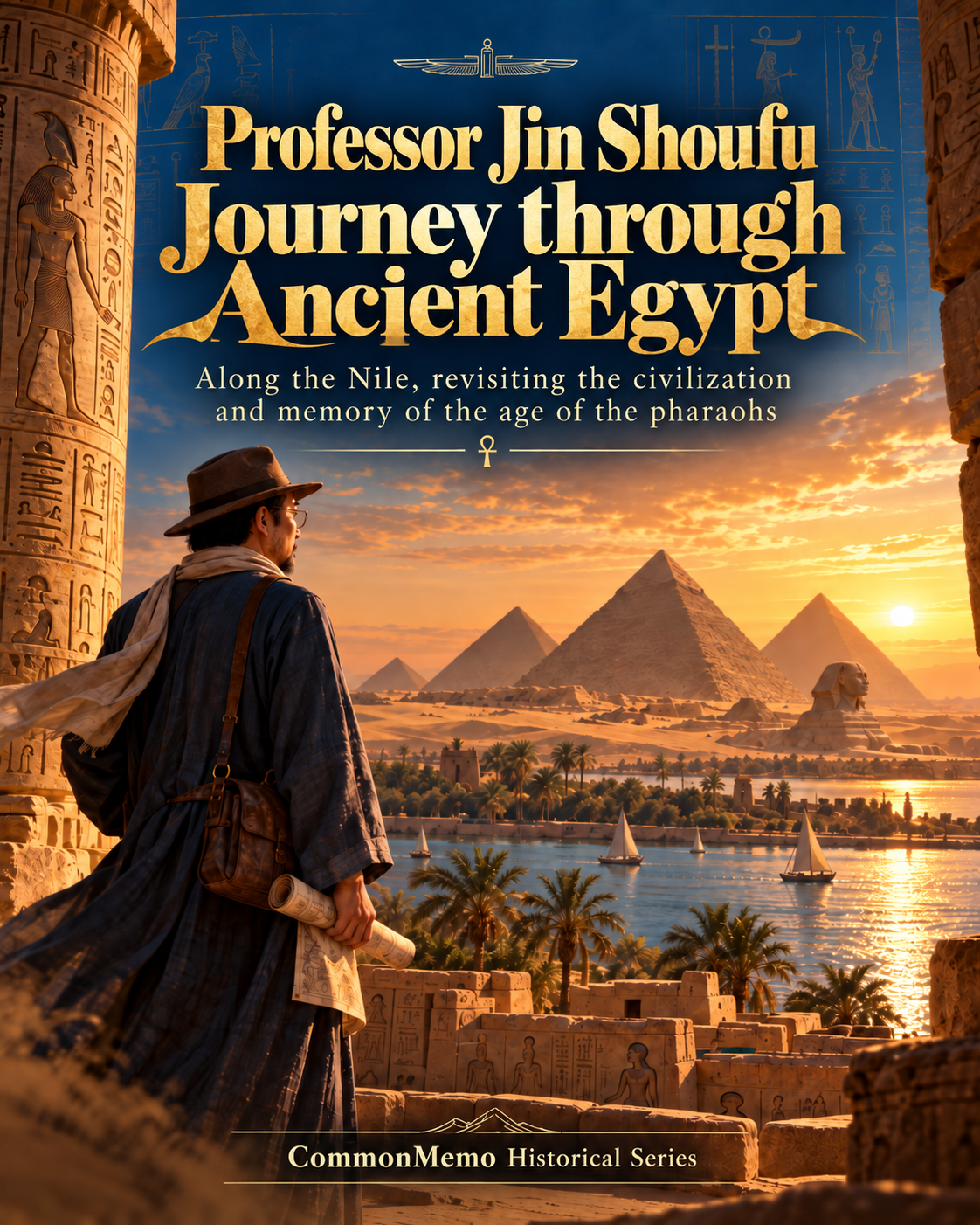
Journey through Ancient Egypt with Professor Jin Shoufu
About this series
The pyramids are an entrance, not the whole of ancient Egypt. Following Jin Shoufu’s Ancient Egyptian Civilization, this bilingual series explores how people governed, worked, married, wrote, worshipped, and imagined another life beside the Nile. It also asks how later generations interpreted—and sometimes reinvented—their world.
Objects, inscriptions, letters, and buildings guide each instalment. We distinguish documented events from religious narratives, later legends, and modern interpretations. Chinese and complete English editions are available, with source notes gathered at the end of each story.
Source author: Professor Jin Shoufu. Editorial adaptation and English rendering: Shitu, with AI assistance. The series title names its scholarly source; these adaptations are not new personal travel accounts by Professor Jin, nor verbatim chapters of his book.
Read the published stories
2 published · 52 instalments in the initial plan
Planned contents
Organized around the manuscript’s twelve lectures and 52 subsections. These are editorial reading topics, not a claim that every story is already published. Titles and divisions may be refined as the evidence is reviewed.
1. Discovering and reconstructing ancient Egypt
- 01The Pyramids Were Always There. Why Did Egypt Need to Be “Discovered”?Published
- 02Deciphering Hieroglyphs: Giving Silent Stones a VoicePlanned
- 03Egyptomania and the Rise of MuseumsPlanned
- 04Two Dimensions of OrientalismPlanned
2. The emergence of civilization
- 05Desert, River, and Prehistoric CulturesPlanned
- 06Specialization, Cities, and ElitesPlanned
- 07A Unified State and KingshipPlanned
3. Officials and administration
- 08The Power of Literacy: Becoming a ScribePlanned
- 09Selecting and Training OfficialsPlanned
- 10Kings, Stone, and Eternal LifePlanned
4. Everyday life
- 11A Strict Social HierarchyPlanned
- 12Love and Marriage beside the NilePlanned
- 13Homes and Family LifePlanned
- 14Endogamy: Who Could Marry Whom?Planned
5. The economy
- 15Agriculture and LandholdingPlanned
- 16Temples as Economic InstitutionsPlanned
- 17Rethinking Slavery and RedistributionPlanned
- 18Heqanakht: Ancient Letters and an Agatha Christie NovelPlanned
6. The world of the gods
- 19Divine Names and ManifestationsPlanned
- 20Images, Temples, and RitualsPlanned
- 21Akhenaten’s Religious ReformPlanned
- 22Personal Piety and the Crisis of PolytheismPlanned
7. The afterlife and burial
- 23Two Eternities: Endurance and RenewalPlanned
- 24Mummies, Coffins, and Tomb ChambersPlanned
- 25Burial Practices and Judgment after DeathPlanned
- 26Letters to the DeadPlanned
8. Writing and literature
- 27How Hieroglyphic Writing WorksPlanned
- 28Writing Materials: Beyond PapyrusPlanned
- 29Autobiographical Literature: A Life InscribedPlanned
- 30Religious Inscriptions: Addressing Gods and the AfterlifePlanned
- 31Admonitory Texts: Voices of CrisisPlanned
- 32Instructions: Advice for the Next GenerationPlanned
- 33Hymns to the Sun and the GodsPlanned
- 34Stories Told by the Ancient EgyptiansPlanned
9. Art
- 35Art in the Service of KingshipPlanned
- 36Art for the AfterlifePlanned
- 37Writing and Images in DialoguePlanned
- 38Men and Women in Egyptian ArtPlanned
- 39Amarna Art: A Different AppearancePlanned
10. Architecture
- 40The Religious Context of ArchitecturePlanned
- 41The Pyramids of Giza and Its SurroundingsPlanned
- 42Karnak and Luxor TemplesPlanned
- 43Building in Stone: Techniques and ToolsPlanned
11. Magic and medicine
- 44Medicine in a Religious WorldPlanned
- 45Doctors and Their SkillsPlanned
- 46Medical Papyri and PrescriptionsPlanned
- 47Mummies and Modern Medical ResearchPlanned
12. Foreign peoples and international contacts
- 48Why Foreigners Were Depicted as EnemiesPlanned
- 49Why Trade Was Represented as TributePlanned
- 50Diplomacy in the Amarna PeriodPlanned
- 51Ancient Israel and Egypt: Texts and HistoryPlanned
- 52The Battle of Kadesh and an Ancient Peace TreatyPlanned