
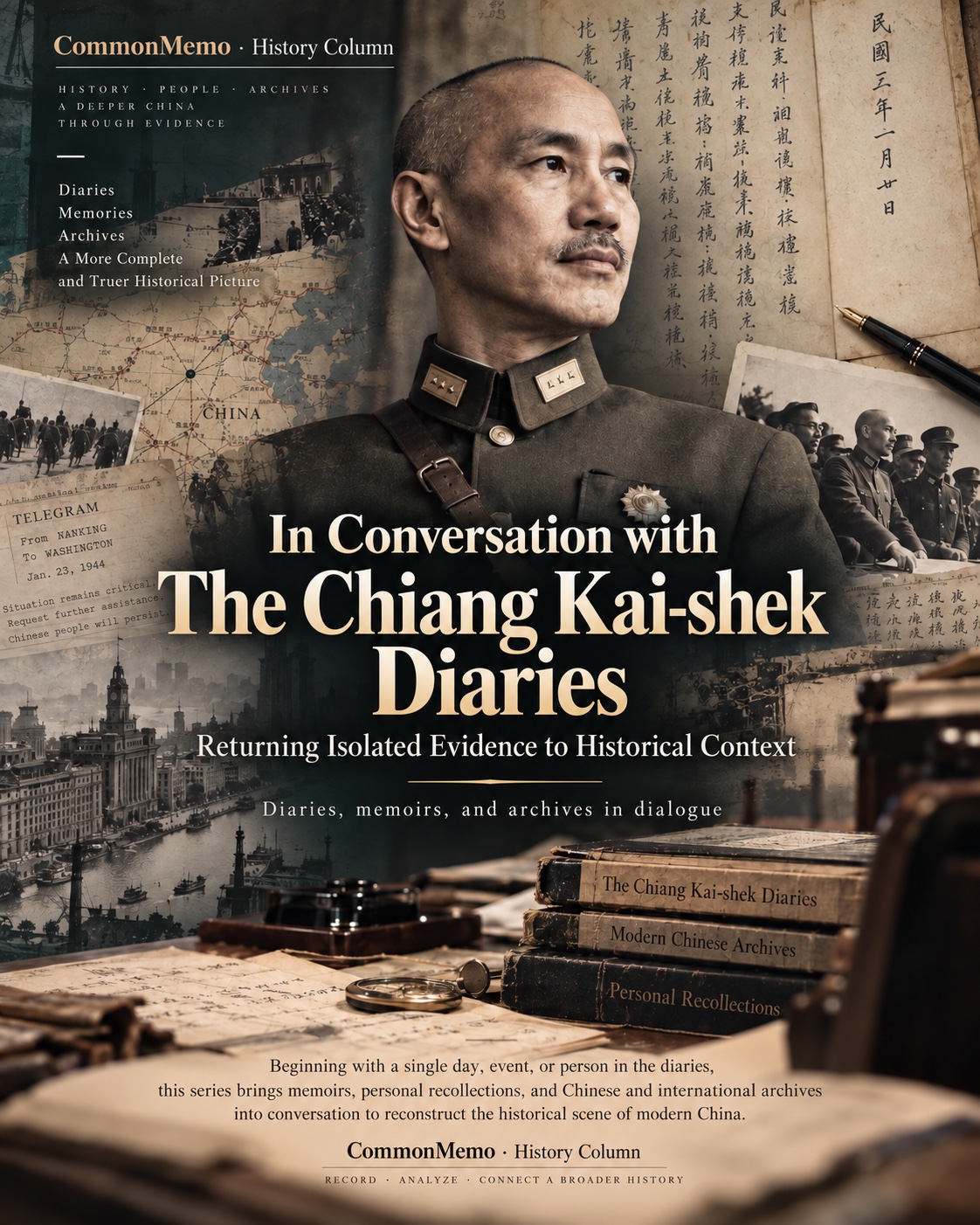
In Conversation with the Chiang Kai-shek Diaries
Returning Isolated Evidence to Historical Context
Beginning with a day, an event, or a person in the diaries, this series brings family recollections, aides, commanders, cultural figures, and Chinese and international archives into conversation. We return one person’s record to the world in which it was made: who knew what, what was misunderstood, where accounts agree, and where they differ. Readable historical stories retain a clear trail of evidence and its limits.
Why this conversation?
A private diary records a perspective, not the whole historical scene. Recollections may preserve what official records omit, but also reshape the past. We distinguish contemporary entries, later recollection, edited copies, and the editor’s interpretation. Conflicting evidence and unknowns remain visible; no invented dialogue or thoughts are presented as fact.
180 planned essays across seven volumes
The plan spans 1917–1972, from early revolutionary life through the mainland and Taiwan years. Topics will be refined as evidence is checked. Only published essays appear below; the complete research catalog is not displayed.
New bilingual essays are scheduled for Fridays and Saturdays at 7:00 a.m. Eastern Time (America/New_York), following daylight-saving changes. The launch essay is a separate manual publication.
Editorial author: Shitu, with AI assistance. Each essay starts with an identifiable diary entry and seeks at least two independent bodies of evidence, including one outside Chiang’s political circle. A source repeated by several repositories does not count as several independent witnesses. If the evidence is insufficient, publication waits.
Published essays
1 essay published