
Memories of Hanshu Figures
Hanshu Figures, Stories, and Memory Across Two Millennia
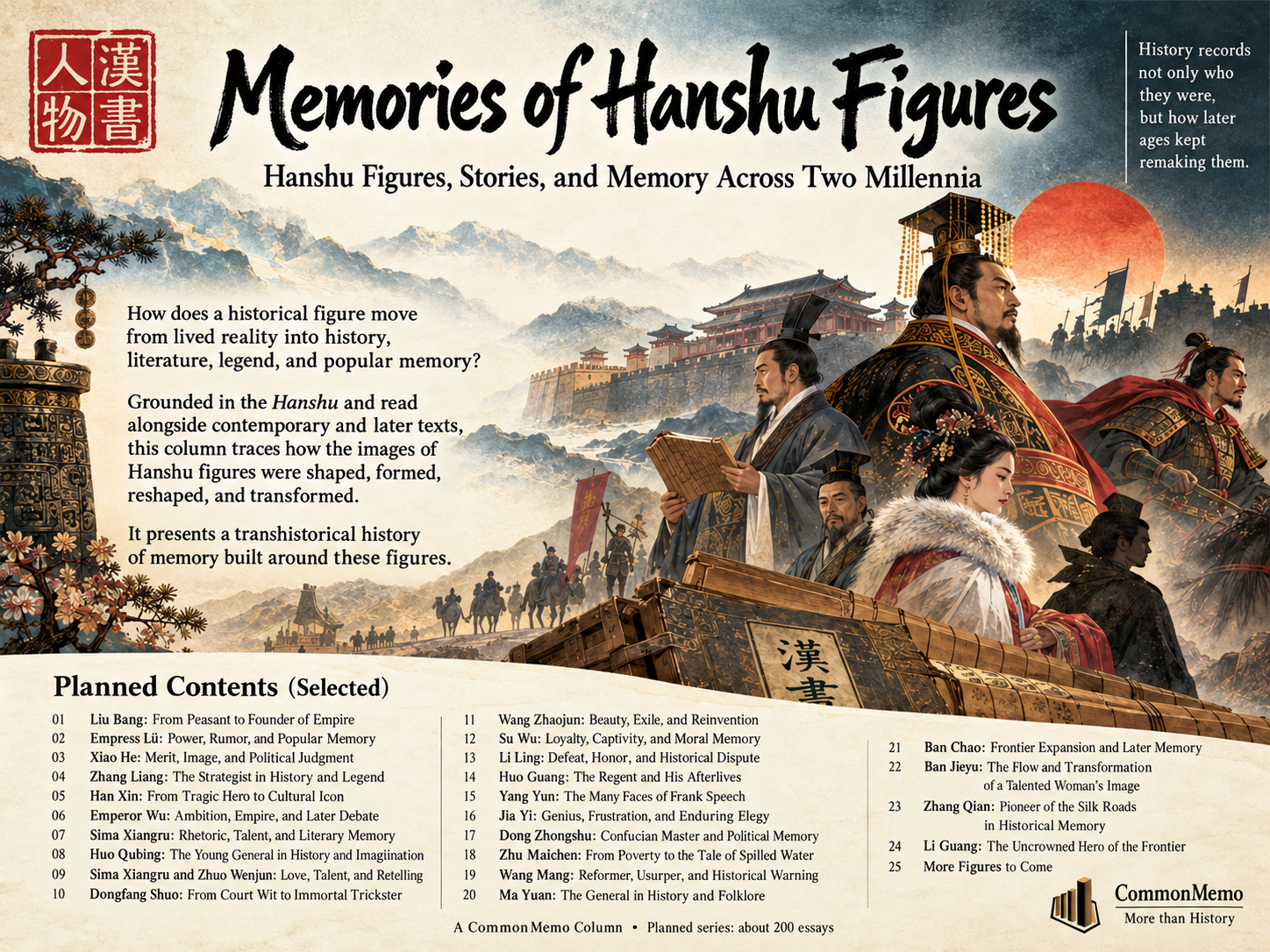
Grounded in the Hanshu (Book of Han), this column reads early evidence alongside later poetry, legends, drama, and images to trace how figures were shaped, remembered, and remade. Lives have histories; so do the memories built around them. Later stories do not by themselves establish events in the Han period, but can provide evidence of how later generations understood these people.
How to read this column
Each essay distinguishes early historical accounts, later retellings, and the editor’s interpretation, with specific sources at the end. The Hanshu itself is a later compilation and must also be read critically. We preserve disagreement and uncertain dates rather than combining conflicting accounts into one supposed eyewitness story.
Editorial author: Shitu, with AI assistance. Chinese essays are accompanied by complete English renderings. These are modern historical narratives, not ancient authors’ own words or personal submissions.
Read the published essays
5 essay published
- Dongfang Shuo: How a Han Courtier Became an Immortal Peach Thief
- Wang Zhaojun: Marriage Diplomacy and Reinvention
- Zhu Maichen: Between a Bundle of Firewood and an Official Seal
- Liu Bang: When the Emperor Came Home, Did the Old Accounts Disappear?
- Empress Lü: Why Did Her Eight Years Become Only the “Human Swine”?
Planned contents
First-stage plan: 200 provisional research topics. The opening essay is Dongfang Shuo; the rest are grouped by theme rather than a fixed publication schedule. This is an editorial research outline, not an original Hanshu index or a claim that all later reception evidence has been verified. Topics may be renamed, merged, or replaced if the sources do not support a full essay. The directory distinguishes published work from planned work.
I. Familiar Figures Reconsidered (30 essays)
- 01Dongfang Shuo: From Courtier to Immortal Peach ThiefPublished
- 02Wang Zhaojun: Marriage Diplomacy and ReinventionPublished
- 03Zhu Maichen: The Making of the Spilled-Water StoryPublished
- 04Liu Bang: Commoner, Emperor, and Founding MemoryPublished
- 05Empress Lü: Power, Cruelty, and Judgments of Female RulePublished
- 06Han Xin: A Founding General Becomes a Tragic HeroPlanned
- 07Zhang Liang: From Imperial Adviser toward ImmortalityPlanned
- 08Xiang Yu: How a Defeated Rival Became a HeroPlanned
- 09Emperor Wu: Conqueror, Tyrant, and Changing JudgmentsPlanned
- 10Su Wu: The Making and Remaking of LoyaltyPlanned
- 11Li Ling: Defeat, Surrender, and Contested MemoryPlanned
- 12Sima Xiangru: Literary Talent and ReputationPlanned
- 13Zhuo Wenjun: A Woman Rewritten through RomancePlanned
- 14Jia Yi: Youthful Talent and the Memory of FrustrationPlanned
- 15Dong Zhongshu: Constructing a Confucian MasterPlanned
- 16Yang Xiong: Thought and Judgments of Political ChoicePlanned
- 17Wang Mang: Reformer, Usurper, and Historical WarningPlanned
- 18Ban Jieyu: A Talented Woman in Later MemoryPlanned
- 19Zhao Feiyan: Beauty and Narratives of Dynastic DeclinePlanned
- 20Zhao Hede: Another Zhao Woman in Court NarrativesPlanned
- 21Li Guang: A General’s Frustration and Later ImaginationPlanned
- 22Huo Qubing: A Young General and Heroic MemoryPlanned
- 23Wei Qing: General, Imperial Relative, and ReputationPlanned
- 24Zhang Qian: An Envoy Becomes a Silk Road SymbolPlanned
- 25Huo Guang: Regency, Succession, and Powerful MinistersPlanned
- 26Xiao He: Ranking Merit and Remembering a MinisterPlanned
- 27Cao Shen: The Making of a Model of Quiet GovernmentPlanned
- 28Chen Ping: Stratagems, Accusations, and Political WisdomPlanned
- 29Zhou Bo: Securing a Dynasty and an Uneasy Old AgePlanned
- 30Ji An: A Frank Adviser and the Historian’s CraftPlanned
II. The Qin–Han Transition and Its Founders (30 essays)
- 31Fan Kuai: Butcher and Hero of HongmenPlanned
- 32Xiahou Ying: Rescue Narratives and LoyaltyPlanned
- 33Guan Ying: A Merchant’s Origins and Military MeritPlanned
- 34Zhou Chang: The Narrative Power of a Stammering AdviserPlanned
- 35Ren Ao: A Local Official in Founding HistoryPlanned
- 36Zhang Cang: Calendars, Institutions, and Bodily AnecdotesPlanned
- 37Shentu Jia: Remembering a Chancellor’s DignityPlanned
- 38Wang Ling: Merit, Motherhood, and Political ChoicePlanned
- 39Chen Xi: Piecing Together a Rebel’s ImagePlanned
- 40Ying Bu: Punishment, Kingship, and RebellionPlanned
- 41Peng Yue: Military Achievement and a Founder’s FatePlanned
- 42King Han Xin: Distinguishing Two NamesakesPlanned
- 43Lu Wan: An Old Friend Becomes an ExilePlanned
- 44Li Yiji: A Persuader’s Confidence and DeathPlanned
- 45Lu Jia: Conquest and the Writing of GovernmentPlanned
- 46Liu Jing: Capital, Marriage Diplomacy, and AdvicePlanned
- 47Shusun Tong: Establishing Ritual and Judging ScholarsPlanned
- 48Ji Bu: The Making of a Promise Worth GoldPlanned
- 49Luan Bu: Former Lords and Choices of LoyaltyPlanned
- 50Tian Heng: Five Hundred Followers and Retellings of DefiancePlanned
- 51Chen Sheng: Rebellion and Later Political MemoryPlanned
- 52Wu Guang: Finding a Person within a Joint BiographyPlanned
- 53Fan Zeng: An Adviser Whose Counsel Went UnusedPlanned
- 54Xiang Liang: Rebellion and the Xiang Family’s MemoryPlanned
- 55Long Ju: A General Remembered through DefeatPlanned
- 56Zhongli Mo: Friendship, Pursuit, and a General’s FatePlanned
- 57Consort Yu: From Brief Record to Stage TragedyPlanned
- 58Liu Fei: The King of Qi and Fraternal HierarchyPlanned
- 59Liu Ruyi: Mother, Son, and the Transmission of Court TragedyPlanned
- 60Emperor Hui: The Construction of a Gentle and Weak RulerPlanned
III. Rulers, Consorts, and Imperial Kin (30 essays)
- 61Emperor Wen: Frugality and the Selection of StoriesPlanned
- 62Emperor Jing: Kingdoms, Family Rule, and JudgmentPlanned
- 63Emperor Zhao: A Young Ruler and His RegentsPlanned
- 64Emperor Xuan: A Story from Common Life to the ThronePlanned
- 65Emperor Yuan: Gentleness and Dynastic ChangePlanned
- 66Emperor Cheng: Court Life and Explanations of DeclinePlanned
- 67Emperor Ai: Ruler, Favourite, and Labels of AffectionPlanned
- 68Emperor Ping: A Child on a Controlled ThronePlanned
- 69Ruzi Ying: Remembering a Final HeirPlanned
- 70Consort Bo: Withdrawal, Motherhood, and FortunePlanned
- 71Empress Dowager Dou: Huang-Lao Politics and Maternal PowerPlanned
- 72Empress Wang of Jing: Marriage and SuccessionPlanned
- 73Wei Zifu: From Singer to EmpressPlanned
- 74Xu Pingjun: The Making of an Old-Sword Love StoryPlanned
- 75Huo Chengjun: Family Power in a Consort’s BiographyPlanned
- 76Wang Zhengjun: A Long-Lived Dowager and Dynastic CollapsePlanned
- 77Consort Ding: Motherhood and Position at CourtPlanned
- 78Empress Dowager Fu: Grandmotherhood, Titles, and PowerPlanned
- 79Feng Yuan: The Bear Episode and the Virtuous ConsortPlanned
- 80Empress Chen: Golden House, Changmen, and Later RomancePlanned
- 81Lady Li: Beauty, Death, and RemembrancePlanned
- 82Consort Zhao: Gouyi Legends and PoliticsPlanned
- 83Princess Guantao: Marriage Networks and PowerPlanned
- 84Princess Pingyang: An Imperial Household and TalentPlanned
- 85Liu Ju: A Crown Prince’s Death and Sorcery MemoryPlanned
- 86Liu Wu: Liang’s Achievement and Succession HopesPlanned
- 87Liu An: The King of Huainan from Books to ImmortalityPlanned
- 88Liu Chang: Fraternal Politics and ExilePlanned
- 89Liu Bi: The King of Wu as RebelPlanned
- 90Liu De of Hejian: An Imperial Collector in Cultural MemoryPlanned
IV. Emperor Wu’s Age and Frontier Worlds (30 essays)
- 91Gongsun Hong: A Chancellor of Humble OriginsPlanned
- 92Zhufu Yan: Rise and Ruin as Political NarrativePlanned
- 93Yan Zhu: Literary Service and Political RiskPlanned
- 94Wuqiu Shouwang: Proposals and Judgments of TalentPlanned
- 95Mei Gao: Rhapsodies, Humour, and Court PositionPlanned
- 96Yan An: Imagining Empire through AdvicePlanned
- 97Xu Yue: A Memorialist’s Judgment of CrisisPlanned
- 98Zhong Jun: The Heroic Young VolunteerPlanned
- 99Sima Qian: Punishment, History, and Self-PresentationPlanned
- 100Jin Midi: Foreign Origins and Loyal ServicePlanned
- 101Shangguan Jie: Regency and Narratives of TreasonPlanned
- 102Sang Hongyang: Fiscal Ability and Long DebatePlanned
- 103Bu Shi: Shepherding, Contributions, and VirtuePlanned
- 104Li Yannian: Music, Favour, and Family FatePlanned
- 105Zhao Chongguo: Agricultural Garrisons and an Elder GeneralPlanned
- 106Xin Qingji: A Military Family and Frontier ExperiencePlanned
- 107Li Guangli: A General’s Achievements and CostsPlanned
- 108Li Cai: A Career beside a More Famous RelativePlanned
- 109Gongsun He: A Chancellor in the Sorcery CrisisPlanned
- 110Gongsun Ao: Military Merit, Failure, and JudgmentPlanned
- 111Gongsun Qing: A Ritual Specialist and Imperial ImmortalityPlanned
- 112Lu Bode: Conquest and the Recording of MeritPlanned
- 113Yang Pu: A Naval General and Southern WarPlanned
- 114Tang Meng: Routes, Envoys, and the SouthwestPlanned
- 115Xu Ziwei: Frontier Construction and Military MemoryPlanned
- 116Zhao Ponu: Victory, Defeat, and ReputationPlanned
- 117Feng Fengshi: Envoy, General, and Competing Claims of MeritPlanned
- 118Fu Jiezi: Assassination, Diplomacy, and Heroic NarrativePlanned
- 119Zheng Ji: The Western Regions Protectorate and MemoryPlanned
- 120Chen Tang: Expedition, Famous Words, and Later Political UsesPlanned
V. Political Lives from Xuan to Wang Mang (30 essays)
- 121Wei Xiang: Caution and Images of GovernmentPlanned
- 122Bing Ji: Protecting a Child and a Chancellor’s ConductPlanned
- 123Zhang Anshi: Constructing a Careful and Trusted MinisterPlanned
- 124Du Yannian: Position within Huo PoliticsPlanned
- 125Tian Yannian: Political Achievement and SuicidePlanned
- 126Han Zeng: A General in Regency NetworksPlanned
- 127Xiao Wangzhi: Scholarship, Tutorship, and Court ConflictPlanned
- 128Zhou Kan: Teaching and Distance from PowerPlanned
- 129Zhang Meng: A Scholar in Political TragedyPlanned
- 130Shi Xian: Eunuch Power and Historical BlamePlanned
- 131Hong Gong: Court Documents and Structures of PowerPlanned
- 132Wang Feng: The Rise of Imperial KinPlanned
- 133Wang Yin: Inheriting Family PowerPlanned
- 134Wang Shang the Chancellor: Between Frank Service and Imperial KinPlanned
- 135Wang Gen: Regency and Wang Mang’s PathPlanned
- 136Wang Li: Imperial Kinship and Family JudgmentPlanned
- 137Wang Tan: An Individual within the Five Marquises StoryPlanned
- 138Wang Chong: Family Favour and Early DeathPlanned
- 139Wang Jin: The Beginning of an Imperial Family NetworkPlanned
- 140Wang Shun: Accession, Persuasion, and ResponsibilityPlanned
- 141Dong Xian: The Cut-Sleeve Allusion and Personal LabelsPlanned
- 142Shi Dan: Reform Debate and Official FortunePlanned
- 143Kong Guang: Caution as a Moral JudgmentPlanned
- 144He Wu: Appointments and Debates over the ChancellorshipPlanned
- 145Zhu Bo: Administrative Ability and Changing FortunePlanned
- 146Peng Xuan: The Political Judgment of WithdrawalPlanned
- 147Bao Xuan: Memorials, Livelihood, and Frank AdvicePlanned
- 148Wang Jia: Remonstrance and a Chancellor’s DeathPlanned
- 149Zhai Fangjin: Portent Politics and Family MemoryPlanned
- 150Zhai Yi: Remembering Resistance to Wang MangPlanned
VI. Classics, Thought, and Scholarly Images (25 essays)
- 151Liu Xiang: Editing, Remonstrance, and Cultural AuthorityPlanned
- 152Liu Xin: Scholarly Transmission and Political ChoicePlanned
- 153Fu Sheng: Remembering an Elder Transmitter of ClassicsPlanned
- 154Shen Gong: A Scholar Faces RecruitmentPlanned
- 155Yuan Gu: Character in Classical DebatePlanned
- 156Han Ying: Connecting Poetry Teaching and StoriesPlanned
- 157Ding Kuan: Classical Teaching and Scholarly LineagePlanned
- 158Shi Chou: The Historical Place of an InterpreterPlanned
- 159Meng Xi: Changes Scholarship and Disputed ReputationPlanned
- 160Liangqiu He: Scholarship, Divination, and CourtPlanned
- 161Ouyang Sheng: A Name in Classical TransmissionPlanned
- 162Xiahou Sheng: Portents, Frank Speech, and TeachingPlanned
- 163Xiahou Jian: Diverging Scholarly PathsPlanned
- 164Jing Fang: Prediction and Political DisasterPlanned
- 165Yi Feng: Correlative Arts and Advice on GovernmentPlanned
- 166Sui Hong: Portent Interpretation and Dangerous SpeechPlanned
- 167Kuang Heng: Borrowed Light and a Chancellor’s Two FacesPlanned
- 168Zhang Yu: Imperial Tutor, Wealth, and Later CriticismPlanned
- 169Kong Anguo: Old-Text Classics and Questions of AttributionPlanned
- 170Wei Xian: Establishing a Scholarly FamilyPlanned
- 171Wei Xuancheng: Inheritance, Renunciation, and Family EthicsPlanned
- 172Gong Yu: Frugality and the Ethics of Official ServicePlanned
- 173Wang Ji: Everyday Politics in RemonstrancePlanned
- 174Mei Fu: An Official’s Withdrawal into Immortality TalesPlanned
- 175Yan Junping: Divination and the Image of a ReclusePlanned
VII. Officials, Knights-Errant, and Social Lives (25 essays)
- 176Zhang Tang: Harsh Official, Able Minister, and Legal MemoryPlanned
- 177Zhao Yu: Constructing a Strict Legal OfficialPlanned
- 178Du Zhou: Between Law and Imperial WillPlanned
- 179Du Qin: Counsel and a Family’s ShadowPlanned
- 180Yi Zong: A Violent Official’s Narrative RolePlanned
- 181Wang Wenshu: Fear as an Instrument of GovernmentPlanned
- 182Yin Qi: Differences within Harsh Officials’ Joint BiographiesPlanned
- 183Hu Jian: Military Law and ResponsibilityPlanned
- 184Yin Wenggui: Integrity and Administrative AchievementPlanned
- 185Zheng Chang: Judging an Official of LawPlanned
- 186Yan Yannian: Severity, Motherhood, and RetributionPlanned
- 187Huang Ba: The Making of a Model Local OfficialPlanned
- 188Gong Sui: Banditry and the Pacification of CommunitiesPlanned
- 189Shao Xinchen: Irrigation, Local Memory, and JudgmentPlanned
- 190Ni Kuan: Poverty, Classics, and AdministrationPlanned
- 191Wen Weng: Schools, Locality, and Cultural AncestorsPlanned
- 192Zhu Yi: Integrity and Posthumous CommemorationPlanned
- 193Guo Jie: A Knight-Errant’s Reputation and State BoundariesPlanned
- 194Zhu Jia: Rescue, Anonymity, and Chivalric MemoryPlanned
- 195Ju Meng: Chivalric Fame and Political OrderPlanned
- 196Chen Zun: The Carriage-Pin Story and Expansive HospitalityPlanned
- 197Lou Hu: Friendship, Eloquence, and Social NetworksPlanned
- 198Yu Dingguo: Fair Judgments and Memories of Good GovernmentPlanned
- 199Shu Guang: Contentment and the Cultural Model of RetirementPlanned
- 200Shu Shou: The Other Figure in the Two Shus’ MemoryPlanned