
Sima Qian’s Historical Memories
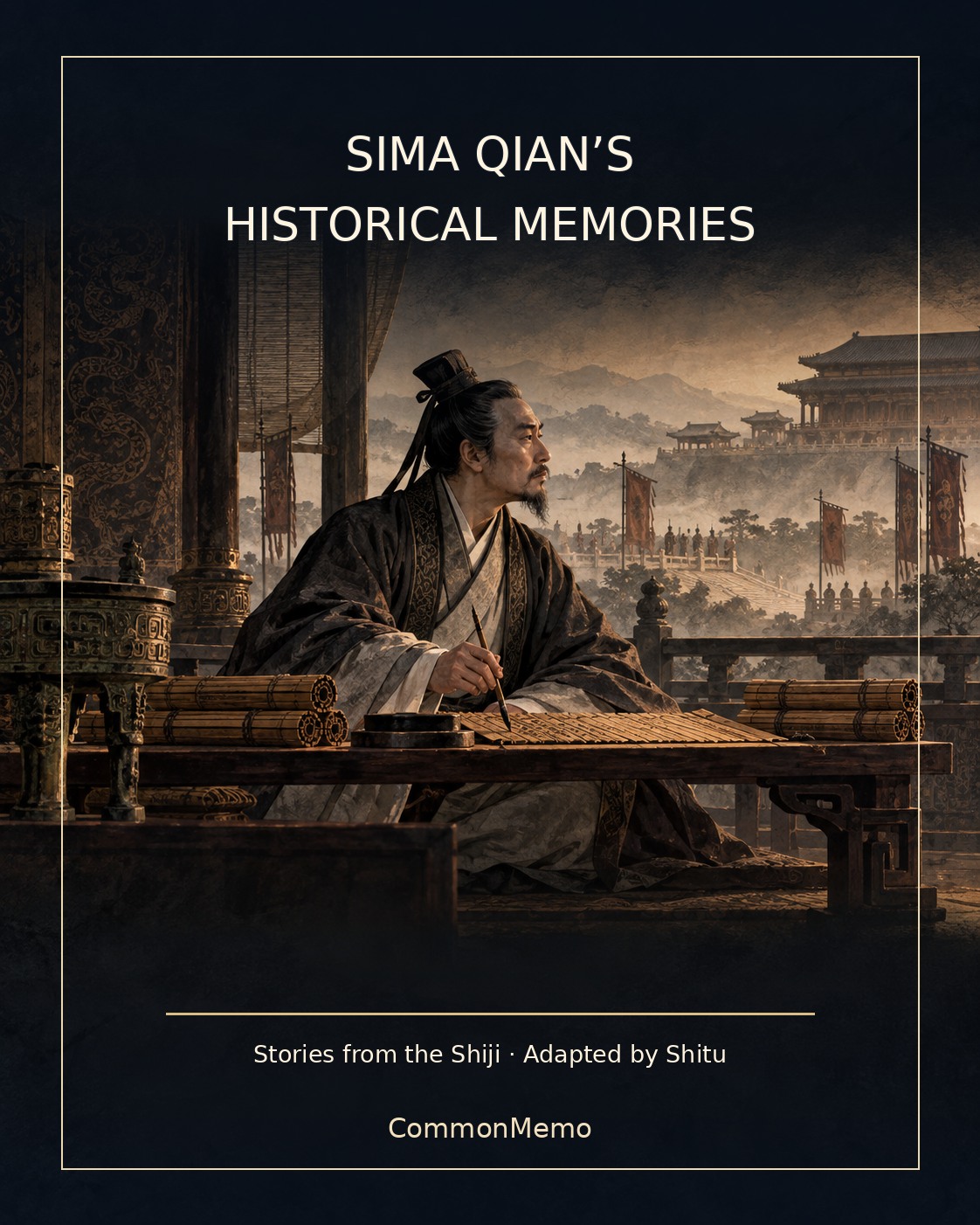
108 lives told in a modern first-person voice, adapted by Shitu from Sima Qian’s Records of the Grand Historian. These are new historical narratives, not Sima Qian’s original words or personal submissions.
Sima Qian: the source author
Sima Qian was a historian of the Western Han and the principal author of the Shiji, known in English as Records of the Grand Historian. He brought the fortunes of rulers and individuals into a single history, connecting political change, institutions, and human lives. Its 130 chapters are organized as basic annals, tables, treatises, hereditary houses, and biographies.
This series approaches ancient China through crises, choices, and their consequences. Sima Qian’s history reaches beyond rulers and victors to unsuccessful contenders, wandering knights, persuaders, and merchants. Events recur across different lives, revealing competing perspectives and inviting readers to consider how a historian connects human action with historical change.
Editorial adaptation
Editorial author: Shitu, with AI assistance. The first-person voice is a modern narrative device. These stories are not the ancient author’s original words, personal submissions, or eyewitness accounts of every event described.
Read the published stories
7 published stories
- 1. Xiang Yu: The River He Would Not Cross
- 2. The Yellow Emperor: After Zhuolu, Who Would Set the World in Order?
- 3. Yao: Who Should Inherit All Under Heaven?
- 4. Shun: From a Well to the Rule of the Realm
- 5. Yu: Thirteen Years of Flood Control and the Succession
- 6. Qi: From Abdication to Hereditary Rule
- 7. Jie: The Fall of Xia and the Loss of the Lords
Planned contents
The opening story is Xiang Yu; from story 2 the sequence begins in legendary antiquity. The 108-person order follows the planning document. These are editorial topics; titles may be refined during research, and planned entries are not yet published.
Opening: Xiang Yu
Legendary Antiquity and Dynastic Beginnings
- 02The Yellow Emperor: Alliances, Zhuolu, and a legendary beginningPublished
- 03Yao: Choosing and testing a successorPublished
- 04Shun: Family crises, service, and successionPublished
- 05Yu: Flood control and the succession to powerPublished
- 06Qi: From abdication to hereditary rulePublished
- 07Jie: The fall of Xia and the loss of alliesPublished
- 08Tang of Shang: Mingtiao and the legitimacy of a new dynastyPlanned
- 09Yi Yin: From the kitchen to the Shang courtPlanned
- 10King Zhou of Shang: Bigan and the dynasty’s last nightPlanned
- 11King Wen of Zhou: Imprisonment at Youli and support in the westPlanned
- 12King Wu of Zhou: Muye and the aftermath of conquestPlanned
- 13The Duke of Zhou: Regency, eastern campaigns, and returning powerPlanned
Spring and Autumn: Hegemony, Exile, and Revenge
- 14Guan Zhong: From enemy archer to the architect of an alliancePlanned
- 15Duke Huan of Qi: Hegemony and a final palace crisisPlanned
- 16Duke Wen of Jin: Nineteen years in exile and ChengpuPlanned
- 17Jie Zitui: Following an exile and withdrawing to MianshangPlanned
- 18Duke Mu of Qin: Baili Xi, defeat at Xiao, and the western RongPlanned
- 19Baili Xi: Five sheepskins and a minister’s careerPlanned
- 20King Zhuang of Chu: Silence, ambition, and the Central PlainsPlanned
- 21Wu Zixu: Flight, Zhaoguan, and the capture of YingPlanned
- 22Shen Baoxu: Seven days of pleading at the Qin courtPlanned
- 23Fuchai of Wu: Victory, rejected counsel, and the fall of WuPlanned
- 24Goujian of Yue: Humiliation at Kuaiji and the defeat of WuPlanned
- 25Fan Li: Rebuilding Yue and leaving power behindPlanned
Thinkers, Teachers, and Military Strategists
- 26Confucius: Travels among the states and hardship in Chen and CaiPlanned
- 27Yan Hui: Poverty, early death, and a teacher’s griefPlanned
- 28Zigong: Persuading rulers and saving LuPlanned
- 29Zilu: Frank counsel and the turmoil in WeiPlanned
- 30Laozi: The Zhou archives and the question at the passPlanned
- 31Yan Ying: Restraint and remonstrance in a troubled QiPlanned
- 32Zhao Jianzi: Rival clans and the choice of an heirPlanned
- 33Zhao Xiangzi: The seizure of Dai and the siege of JinyangPlanned
- 34Sun Wu: A palace drill and the limits of military ordersPlanned
- 35Wu Qi: Reform in Wei and Chu, and a king’s deathPlanned
- 36Sun Bin: Punishment and the plan at MalingPlanned
- 37Pang Juan: Former friends and defeat at MalingPlanned
Warring States: Reform, Persuasion, and Survival
- 38Shang Yang: Trust, reform, and the law turned against its makerPlanned
- 39Su Qin: The six-state alliance and a persuader’s dangerous roadPlanned
- 40Zhang Yi: Qin’s alliances, the deception of Chu, and self-defencePlanned
- 41Marquis Wen of Wei: Talent and the rise of WeiPlanned
- 42Chunyu Kun: Riddles for a king and an embassy to ZhaoPlanned
- 43Zou Ji: Music and reform at the Qi courtPlanned
- 44Mencius: Persuading kings through benevolence and righteousnessPlanned
- 45Xunzi: Jixia and the later years in LanlingPlanned
- 46Qu Yuan: Exile and news from ChuPlanned
- 47Tian Dan: Jimo and the fire-ox attackPlanned
- 48Yue Yi: Conquest in Qi, exile in Zhao, and a letter in replyPlanned
- 49Li Mu: Frontier defence and Zhao’s last pillarPlanned
The Four Lords and the Advance of Qin
- 50Lord Mengchang: Retainers and escape through Hangu PassPlanned
- 51Lord Xinling: The stolen tally and Wei’s last opportunityPlanned
- 52Lord Pingyuan: Choices during the siege of HandanPlanned
- 53Lord Chunshen: Relief for Zhao, a fief in Wu, and death at his gatePlanned
- 54Lin Xiangru: The jade, Mianchi, and reconciliationPlanned
- 55Lian Po: Before Changping, apology, and exilePlanned
- 56Zhao She: A narrow road and victory at EyuPlanned
- 57Bai Qi: Yique, Changping, and the end at DuyouPlanned
- 58Fan Ju: Humiliation, office in Qin, and distant alliancesPlanned
- 59Lü Buwei: An opportunity in Handan and a chancellor’s fallPlanned
- 60Li Si: The expulsion debate, unification, and imprisonmentPlanned
- 61Jing Ke: Farewell at the Yi River and the attack at XianyangPlanned
The Fall of Qin and the Rise of Chu and Han
- 62The First Emperor of Qin: Tours and imperial projects after unificationPlanned
- 63Fusu: A letter to Shangjun and orders from ShaqiuPlanned
- 64Huhai: The Second Emperor and Wangyi PalacePlanned
- 65Zhao Gao: Altered orders and a deer called a horsePlanned
- 66Meng Tian: Northern defences and forced suicidePlanned
- 67Chen Sheng: Dazexiang and kingship at ChenPlanned
- 68Wu Guang: Shared rebellion and an army’s fatal divisionsPlanned
- 69Zhang Han: Qin’s last great commander and JuluPlanned
- 70Xiang Liang: Rebellion in Wu and defeat at DingtaoPlanned
- 71Fan Zeng: Hongmen, frustrated counsel, and illnessPlanned
- 72Liu Bang: Entry into the passes, war with Chu, and the founding of HanPlanned
Early Han: Founding and the Redistribution of Power
- 73Zhang Liang: Bolangsha, Hongmen, and plans for victoryPlanned
- 74Han Xin: Humiliation, command, victory over Zhao, and Weiyang PalacePlanned
- 75Xiao He: Pursuing Han Xin, guarding Guanzhong, and self-discreditPlanned
- 76Chen Ping: Stratagems and the overthrow of the Lü clanPlanned
- 77Peng Yue: Warfare in Liang and the end of a founding generalPlanned
- 78Ying Bu: From Chu to Han and rebellion in HuainanPlanned
- 79Fan Kuai: Entering the tent at Hongmen and a general’s familyPlanned
- 80Cao Can: Office in Qi and following Xiao He’s policiesPlanned
- 81Empress Lü: Founding struggles, power, and palace fearsPlanned
- 82Lady Qi: The succession struggle and its tragedyPlanned
- 83Guan Ying: Pursuit to the Wu River and securing HanPlanned
- 84Zhou Bo: Military service, the Lü clan, and Emperor Wen’s accessionPlanned
Emperors Wen and Jing, and the Eve of Emperor Wu
- 85Emperor Wen of Han: From Dai to the capital and frugal governmentPlanned
- 86Emperor Jing of Han: Reducing princely power and the Seven StatesPlanned
- 87Empress Dowager Dou: Family power, Huang-Lao thought, and court debatePlanned
- 88Chao Cuo: Plans against the princes and death in the eastern marketPlanned
- 89Zhou Yafu: Xiliu, the Seven States, and starvationPlanned
- 90Jia Yi: A young scholar from Luoyang and exile to ChangshaPlanned
- 91Yuan Ang: Frank advice and the crisis of the Seven StatesPlanned
- 92Deng Tong: Imperial favour and confiscated wealthPlanned
- 93Dou Ying: War, court debate, and executionPlanned
- 94Tian Fen: A powerful minister’s banquet and the Guan Fu casePlanned
- 95Gongsun Hong: From commoner to chancellor and recommending talentPlanned
- 96Zhufu Yan: Dividing princely inheritance and the king of Qi’s deathPlanned
Emperor Wu: Frontiers, Literature, and Historians
- 97Emperor Wu of Han: Reform, campaigns, and the costs of governmentPlanned
- 98Wei Qing: From mounted servant to commander-in-chiefPlanned
- 99Huo Qubing: A young commander and the northern campaignsPlanned
- 100Li Guang: The Xiongnu frontier, a lost route, and suicidePlanned
- 101Zhang Qian: A mission west and the road homePlanned
- 102Dong Zhongshu: Spring and Autumn learning and imperial ConfucianismPlanned
- 103Sima Xiangru: Rhapsodies, Changmen, and southwestern missionsPlanned
- 104Zhuo Wenjun: A choice at Linqiong and making a livingPlanned
- 105Dongfang Shuo: A long memorial and satire at courtPlanned
- 106Huo Guang: Serving Emperor Wu and a final chargePlanned
- 107Sima Tan: Missing the Feng and Shan rites and entrusting the historyPlanned
- 108Sima Qian: Punishment, endurance, and completing the ShijiPlanned