
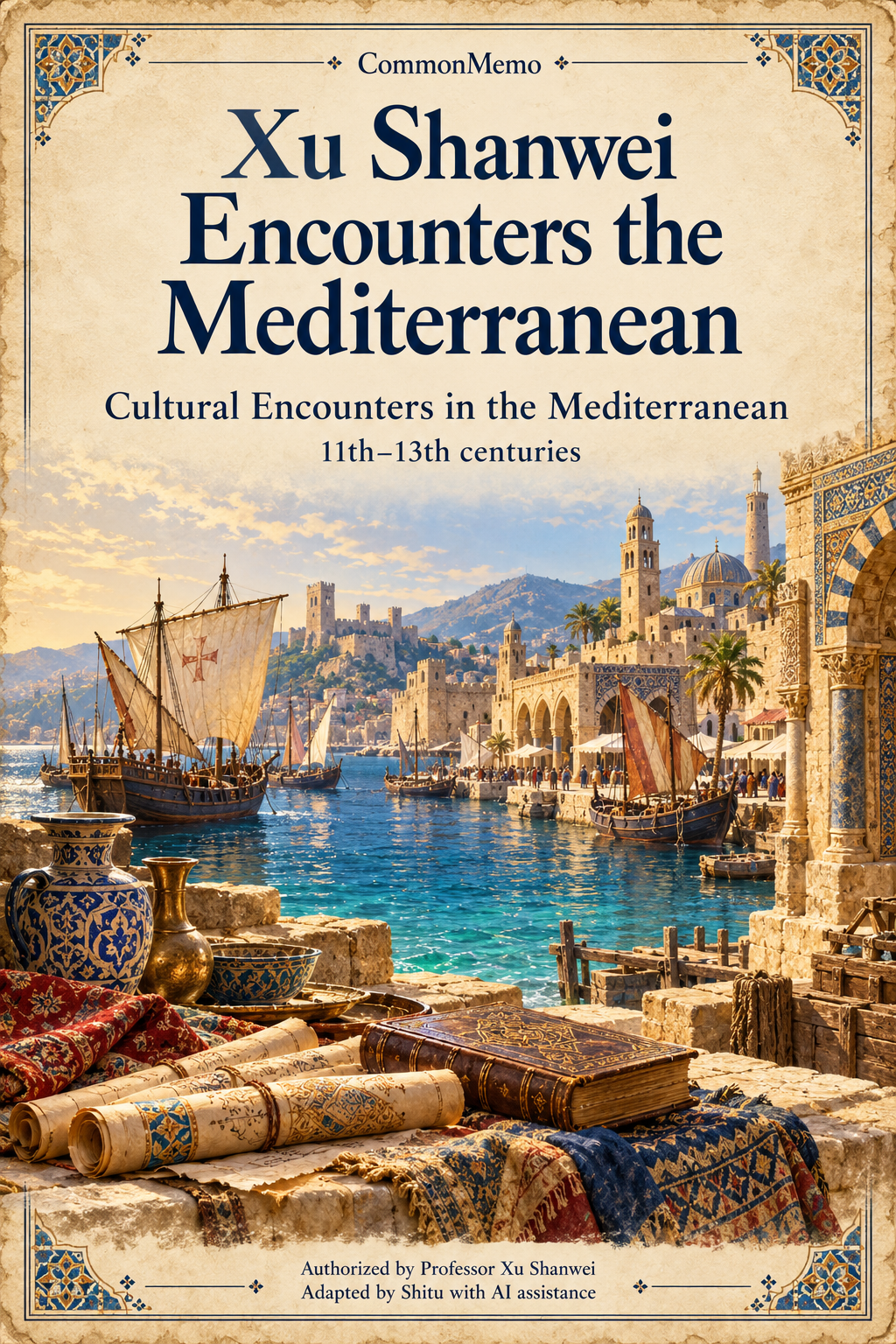
Xu Shanwei Encounters the Mediterranean
Cultural Encounters in the Mediterranean
Xu Shanwei · Professor of European medieval history, Shanghai Normal University, China
About this series
The Mediterranean was a sea of war, but also a sea travelled by merchant ships, pilgrims, translators, physicians, craftspeople, and books.
Between the eleventh and thirteenth centuries, the Latin West re-entered a world connecting Europe, Asia, and Africa. Here, westerners encountered Byzantine, Arabic, Jewish, and more distant eastern civilizations. Through warfare, trade, migration, religious activity, and translation, they met things previously unfamiliar to them: new medicine, mathematics and astronomy, navigational techniques, foods and clothing, urban ways of life, poetry, and ideas about love.
These things did not move unchanged from one civilization to another. They were translated between languages, questioned across faiths, assigned new values in markets and courts, and put to new uses in schools, ports, homes, and at the table. Knowledge from elsewhere became local institutions; foreign objects became everyday necessities; unfamiliar ideas eventually became part of what people took for granted.
Xu Shanwei Encounters the Mediterranean takes Xu’s doctoral thesis, The Westward Transmission of Eastern Learning and the Revival of Western Culture, as its foundation. Drawing on work from the past three decades in Mediterranean history, translation studies, the history of science, archaeology, and material culture, it uses a historian’s first-person voice to tell stories unfolding at cultural boundaries.
The series treats neither East nor West as a self-contained whole, and does not reduce cultural exchange to a one-way transfer. It asks where people met, how they misunderstood one another, how they learned from and transformed foreign things, and why a culture eventually made something once unfamiliar part of its own tradition.
A compass, a bathhouse, a translated book, a merchant ship moored in port, a poem about love: together, these particular stories form a history of culture in motion.
Reading note
The series uses a first-person historical voice addressing an implied reader. Xu Shanwei enters the narrative as a historian who selects evidence, raises questions, and makes judgments. It invents no personal experiences and does not turn disputed scholarly arguments into unqualified conclusions. Historical evidence, the author’s interpretation, and later research are read in relation to one another.
Starting from the Mediterranean, we reconsider how culture takes shape through encounters.
Read the published essays
3 published · Five parts, 34 planned essays
Planned contents
The complete outline has 34 essays in five parts. Essays 1–30 form the initial core; 31–34 extend and conclude the series. These are planned topics, not claims of publication or settled scholarly conclusions. Sources and causal claims will be reviewed for each essay.
Part One · Reopening the Mediterranean
- 01The Mediterranean Reopens to the WestPublished
- 02Three Languages in SicilyPublished
- 03Frederick II’s Multilingual CourtPublished
- 04Toledo after the ConquestPlanned
- 05The East the Crusaders Brought HomePlanned
- 06A Second Home for MigrantsPlanned
Part Two · Merchants, Pilgrims, and People on the Move
- 07Foreign Quarters in ConstantinoplePlanned
- 08Caffa on the Black SeaPlanned
- 09Lodgings in AlexandriaPlanned
- 10Merchants Brought More than GoodsPlanned
- 11The Pilgrim’s PursePlanned
- 12Marriage, Law, and Mixed FamiliesPlanned
Part Three · How Translation Changed the World
- 13A Western World That Could Not Read GreekPlanned
- 14Constantine and the First Arabic Medical TextsPlanned
- 15The Translation Table in ToledoPlanned
- 16Jewish Scholars: An Unseen BridgePlanned
- 17After Aristotle Was BannedPlanned
- 18Aristotle in ArabicPlanned
- 19Four Voices at the Medical School of SalernoPlanned
- 20From Reciting Old Books to Observing the BodyPlanned
- 21The Journey of a CompassPlanned
- 22Where Did the Windmill Come From?Planned
Part Four · How Foreign Things Became Part of Local Culture
- 23From Arabic Bathhouses to European Public BathsPlanned
- 24Sugar, Rice, and Spices Travel WestPlanned
- 25How Cotton Changed European WardrobesPlanned
- 26Why Westerners Favoured Eastern DressPlanned
- 27Eastern Details in the CastlePlanned
- 28A Gold Coin and a Promissory NotePlanned
Part Five · Literature, Art, and Emotional Life
- 29Where Did Love Poetry Come From?Planned
- 30How Romantic Love Took ShapePlanned
- 31Eastern Traces in the ChurchPlanned
- 32From Eastern Music Theory to Western MusicPlanned
- 33How a University Learned to ThinkPlanned
- 34From the Mediterranean to the AtlanticPlanned
Scholarly foundation
Xu Shanwei, The Westward Transmission of Eastern Learning and the Revival of Western Culture (a working translation of the Chinese title). The supplied Chinese manuscript is the foundation; later evidence is checked and identified separately in each essay.
Shanghai Normal University · Xu Shanwei’s academic profile